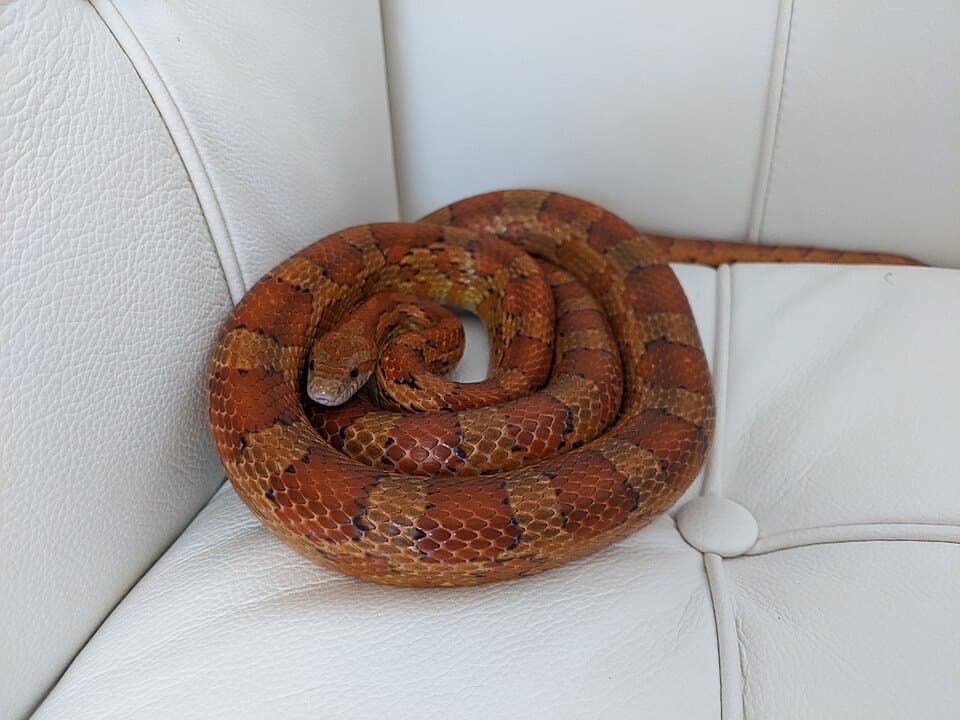
Corn snake
Also known as Red rat snake, Pantherophis guttatus
- Adult size
- 120–150 cm long
- Lifespan
- 15–20 years
- Origin
- South-eastern and central United States
- Company
- Best housed alone; cohabiting risks stress and cannibalism at feeding time
- Docile
- Curious
- Escape-prone
- Hardy
About the Corn snake
Corn snakes are slender, non-venomous constrictors from fields, woodland edges and farm buildings in the south-eastern United States. Their name may come from their presence around corn stores, where rodents gathered, or from the patterned belly scales resembling maize kernels; both explanations are widely repeated.
They are widely regarded as one of the easiest snakes to keep, being docile, moderately sized and reliable feeders on frozen-thawed rodents. Captive breeding has produced countless colour and pattern forms. They are, however, skilled escape artists that need a secure enclosure for two decades or more.
Temperament
Most corn snakes are calm and tolerate regular handling once they are used to it. Hatchlings can be nippy and quick, and may vibrate their tails or musk when frightened. Adults are usually curious and inclined to explore hands and arms rather than staying still.
Enclosure, heat & light
An adult needs a secure, lockable vivarium of at least around 120 x 60 x 60 cm, giving room to stretch out and climb. Provide a warm end and a cool end using a heat mat or overhead heater, always on a thermostat and checked with a thermometer. Low-level UVB is increasingly recommended, though they have historically been kept without it. Aspen, beech chips or soil-based substrates allow burrowing; offer hides at both ends, branches and a water bowl large enough to soak in.
Diet
Corn snakes eat appropriately sized frozen-thawed rodents, roughly as wide as the widest part of the snake's body. Hatchlings are fed about every 5–7 days, while adults usually eat every 10–14 days. Thaw prey fully and warm it to around body temperature before offering with tongs, and never feed live rodents, which can injure the snake. Avoid handling for a day or two after a meal to reduce regurgitation.
Enrichment & handling
Branches for climbing, cork tubes, plants and a deep substrate for burrowing add interest. Occasionally rearranging furniture or offering supervised exploration outside the enclosure gives new experiences. Support the body loosely with both hands, letting the snake move through your fingers rather than restraining it.
Shedding & hygiene
Healthy corn snakes shed their skin in one piece every few weeks to months; eyes turn milky blue beforehand. Raising humidity slightly during this time and providing a humid hide helps. Check that the eye caps and tail tip have come away, spot-clean waste promptly and wash your hands after handling.
Health
Retained shed, respiratory infections in cold or damp conditions, mouth rot and obesity from overfeeding are the most common problems. Mites can appear as tiny moving dots around the eyes or in the water bowl. Snakes that regurgitate repeatedly or refuse food for long periods while losing weight should see an exotics vet.
Prone to
- Retained shed
- Respiratory infection
- Mouth rot
- Snake mites
- Obesity
Call a vet if you notice
- Wheezing, bubbles from the nostrils or open-mouth breathing
- Swelling, redness or pus in the mouth
- Repeated regurgitation
- Retained eye caps or several stuck sheds
- Visible mites around the eyes or on the body
- Lying limp, twisted or unable to right itselfEmergency
A vet with experience of exotic pets is best placed to help. Find one before you need them.
Common questions
Do corn snakes bite?
Bites are uncommon and not dangerous, though hatchlings may strike when frightened. Most bites happen when a hand smells of food, so wash hands before handling.
How often should I feed my corn snake?
Hatchlings usually eat every 5–7 days and adults every 10–14 days, adjusted for body condition. A slight bump after feeding is normal, but an adult should not look round or have fat rolls.
Do corn snakes need UVB?
They can live without it, but low-level UVB is increasingly recommended as beneficial. If you add it, provide plenty of shade and hides.
Why is my corn snake not eating?
Common reasons include an upcoming shed, recent rehoming, low temperatures or seasonal slowing in winter. If the snake loses weight or seems unwell, see a vet.
Written by the Petopedia editorial team to our editorial standards. General guidance, not veterinary advice.