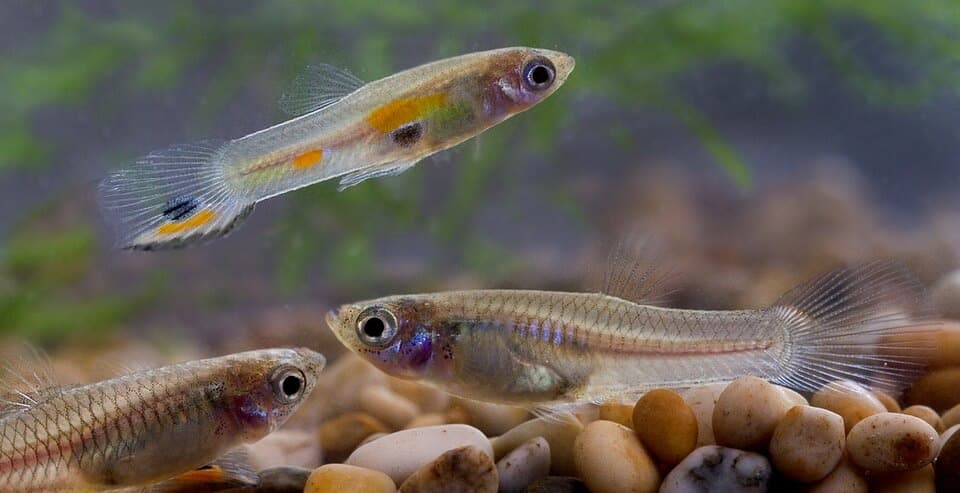
Guppy
Also known as Millionfish, Rainbow fish, Poecilia reticulata
- Adult size
- Males about 3 cm, females up to about 5–6 cm
- Lifespan
- 1–3 years
- Origin
- North-eastern South America and nearby Caribbean islands, including Trinidad and Venezuela
- Company
- Keep in a group, with more females than males
- Lively
- Peaceful
- Colourful
- Prolific
About the Guppy
Guppies are small, lively livebearers whose males flaunt brilliantly coloured, often oversized tails. Breeders have produced a huge range of colour strains and fin shapes, while females are larger, plainer and rounder.
Guppies give birth to live young rather than laying eggs, and they breed so readily that a few fish can soon become dozens. Anyone keeping both sexes needs a plan for the fry.
They are popular for community tanks because they are peaceful, active and colourful. Heavily inbred fancy strains, however, can be less robust than their wild-type relatives.
Temperament
Guppies are peaceful fish that suit community tanks with other small, gentle species. Males chase females persistently, so a ratio of roughly one male to two or three females spreads the attention, or a male-only tank avoids breeding altogether. Their long tails attract fin-nippers such as some barbs and tetras, and larger fish may eat them.
Tank & water
A tank of around 40–60 litres or more suits a small group, with a heater keeping the water at about 22–28°C. Guppies prefer moderately hard, slightly alkaline water and a gentle filter, as long-finned males tire in strong currents. Plenty of fine-leaved plants or floating plants give females a break from males and help fry survive. Cycle the tank before adding fish.
Diet
Guppies are omnivores that do well on a quality flake or micro-pellet food. Add small frozen or live foods such as daphnia and brine shrimp, along with some plant matter. Feed small amounts once or twice daily, as their stomachs are tiny.
Behaviour & tank mates
Guppies are constantly on the move, exploring all levels of the tank and displaying to one another. Live plants add interest and give cover, and floating plants are especially useful for newborn fry. Watching the social behaviour of a well-balanced group is part of their appeal.
Tank maintenance
Change around 20–25% of the water weekly and gently vacuum the substrate. A growing population increases waste quickly, so keep an eye on stocking levels and test the water regularly.
Health
Guppies can suffer from white spot, fin rot, columnaris (a bacterial infection that may look like cottony patches) and internal parasites. Fancy strains can be delicate, so buying healthy fish from good sources and quarantining newcomers helps a great deal. If several fish fall ill, test the water and seek advice from an aquatic vet or specialist.
Prone to
- White spot (ich)
- Fin rot
- Columnaris
- Internal parasites
- Birthing difficulties in females
Call a vet if you notice
- Several fish gasping at the surface — test the waterEmergency
- White cottony patches on the body or mouth
- Fins clamped and the fish shimmying on the spot
- Thin, stringy white droppings and weight loss
- A heavily pregnant female struggling or lying on her side
An aquatic vet or experienced aquatic specialist is best placed to help. Find one before you need them.
Common questions
How often do guppies have babies?
Females can give birth roughly every month, and can store sperm to produce several broods after a single mating. This is why guppy numbers grow so quickly.
Do guppies eat their babies?
Yes, adult guppies will often eat fry. Dense plants or floating plants give the young places to hide.
How many guppies should I keep together?
A small group is best, with two or three females per male if you keep both sexes. An all-male group is a good option if you do not want fry.
Written by the Petopedia editorial team to our editorial standards. General guidance, not veterinary advice.