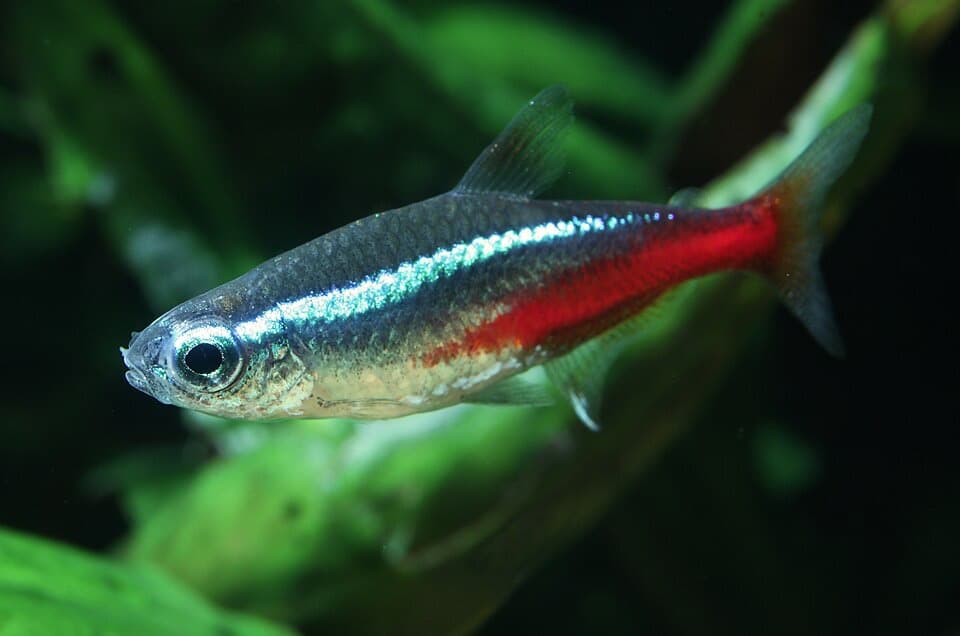
Neon tetra
Also known as Neon, Paracheirodon innesi
- Adult size
- About 3–4 cm
- Lifespan
- 3–8 years
- Origin
- Blackwater and clearwater streams of the western Amazon basin, including Peru, Colombia and Brazil
- Company
- Keep in a shoal of at least 6, and ideally more
- Shy
- Peaceful
- Iridescent
- Shoaling
About the Neon tetra
The neon tetra is a tiny shoaling fish with an iridescent blue stripe and a red band along the lower half of the body. A group swimming together in a planted tank is one of the classic sights of the aquarium hobby.
In the wild, neons live in soft, acidic waters shaded by forest, where their reflective colours may help members of the shoal keep track of one another. Most neons sold today are farm-bred and adapted to a wider range of water conditions.
Neons are small and delicate, and they are best added to a mature, stable tank rather than one that has only just been set up.
Temperament
Neon tetras are peaceful, timid fish that only feel secure in a shoal. Kept in too small a group they hide and lose colour. They make excellent companions for other small, gentle fish, but anything with a mouth large enough, including adult angelfish, may eat them.
Tank & water
A shoal of neons needs a heated tank of around 60 litres or more, kept at roughly 20–26°C. Soft, slightly acidic water suits them best, though captive-bred fish adapt to moderate conditions if the water is stable. Gentle filtration, dense planting and subdued lighting or floating plants help them feel secure. Dark substrate brings out their colours.
Diet
Neons are omnivores with small mouths, so offer quality micro-pellets or crushed flake. Small frozen or live foods such as daphnia, brine shrimp and cyclops add variety. Feed small amounts once or twice a day.
Behaviour & tank mates
Neon tetras are most confident and colourful in a large shoal moving through open water between plants. Planted areas, driftwood and leaf litter mimic their natural home and provide shelter. Calm, slow-moving tank mates help them settle.
Tank maintenance
Change around 20–25% of the water weekly with dechlorinated, temperature-matched water. Avoid big, sudden changes in water chemistry, which neons tolerate poorly.
Health
Neon tetra disease is a parasitic infection that causes pale patches under the skin, a curved spine and loss of colour; there is no reliable treatment, so affected fish are usually removed to protect the rest. Neons are also prone to white spot and fin rot, especially after transport or in unstable water. Quarantine new fish and consult an aquatic vet or experienced specialist if several fish become unwell.
Prone to
- Neon tetra disease
- White spot (ich)
- Fin rot
- Columnaris
Call a vet if you notice
- Several fish gasping or hanging near the surface — test the waterEmergency
- Pale, whitish patches beneath the skin and fading stripe
- A bent or curved spine
- A fish swimming apart from the shoal or restlessly at night
- Cottony growths on the body or mouth
An aquatic vet or experienced aquatic specialist is best placed to help. Find one before you need them.
Common questions
How many neon tetras should I keep together?
At least six is the usual minimum, but they are more confident and natural in larger groups. A bigger shoal also spreads out any squabbling.
Why are my neon tetras losing colour?
Neons fade at night, when stressed or when water conditions are poor. Persistent loss of colour, especially with pale patches, can be a sign of disease.
What is the difference between neon and cardinal tetras?
In neons the red band runs only along the rear half of the body, while in cardinals it runs the full length. Cardinals also prefer warmer water.
Can neon tetras live with angelfish?
It is risky. Small angelfish may ignore them, but adult angelfish often eat neons.
Written by the Petopedia editorial team to our editorial standards. General guidance, not veterinary advice.